Understanding the Outeniquasbosch Landscape Manual
Understanding the Outeniquasbosch Landscape Manual: Your Garden, Rehabilitation Area, and Green Areas Explained
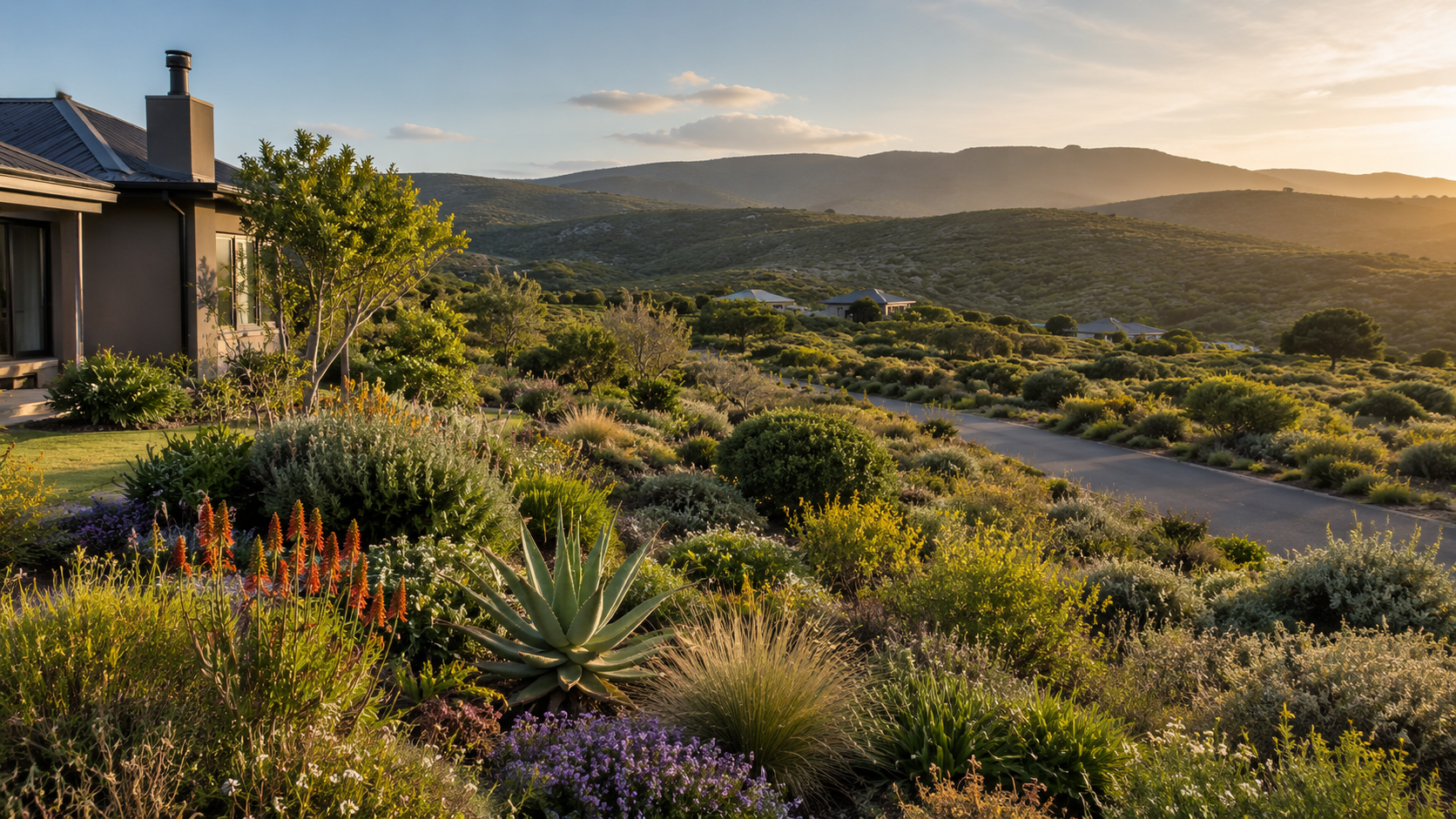
Outeniquasbosch was never meant to be a garden estate in the conventional sense. It was built on land that once supported a mosaic of fynbos, renosterveld and valley bushveld, and the guiding idea behind our Landscape Manual is simple: bring that mosaic back. Every private garden, street front, and rehabilitation area is a chance to knit the village nodes back into the surrounding habitat, so that the estate reads as one continuous natural landscape rather than a collection of fenced-off plots.
This isn’t just an aesthetic preference. Wildlife moves through Outeniquasbosch, including across private stands and the corridors between them. Animals will browse and graze wherever there is palatable vegetation, which means the plants we choose and how we protect them while they establish matters as much as the intention behind them.
Three types of gardens, three sets of rules
The Manual splits every property into three zones, each with its own approach:
- Enclosed Private Garden areas are fenced within the building line, keeping wildlife out. Here you have the most freedom: plant as you like, though indigenous species are preferred, and any exotics are confined to pots or containers and must never be known spreaders or invaders.
- Open Private Garden areas are unfenced and therefore open to browsing and grazing. Only locally indigenous species from the approved plant list may go in here.
- Street front areas, between the curb and your building line, are technically public spaces but are yours to stabilize, plant and maintain. Indigenous grasses such as kweek or buffelgrass are preferred for lawns; kikuyu is permitted only where it’s contained between curb and paving so it can’t spread into rehabilitation areas. Important: no trees are permitted within 5m of the road verge (pavement), and only locally indigenous plants from our approved plant list may be planted here.
Rehabilitation areas are part of your erf, but not an extension of your garden
The rehabilitation area is the part of your erf between the building line and the boundary lines. It still belongs to your stand, but it is not a garden: it must be left to return to natural veld, not treated as an extension of your lawn or planted to taste. Only locally indigenous plants and trees from the approved plant list may go in here, and no hard landscaping (paving, structures, pathways and the like) is allowed. No permanent structures may be added in this area, other than the firefighting sprinkler system.
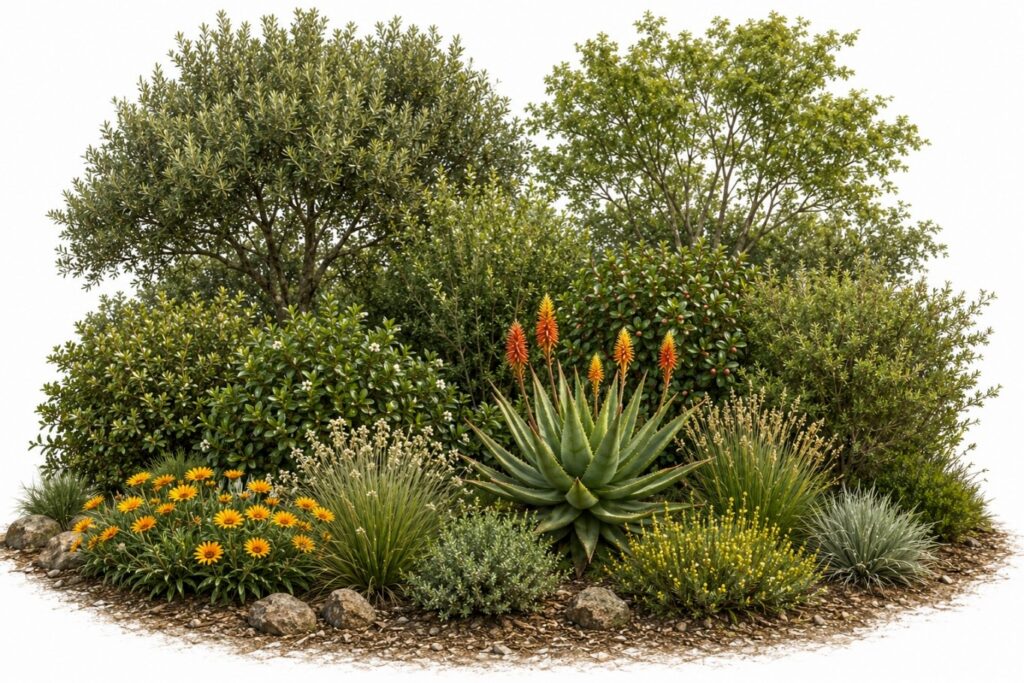
As the owner, you have six months from occupation to plant the minimum requirement of three trees and five shrubs in the bush clump formation, mimicking how vegetation naturally clusters in the wild. Young plantings may need temporary screening (jackal-proof mesh on poles or droppers) to survive browsing before they’re established. Mowing is limited to a one-meter strip along the building line, and no herbicide or other chemical treatment may be used without prior written approval from the ECO or Landscaping Committee. You remain responsible for keeping the area free of declared invasive species.
Green areas belong to all of us
Green areas are the communal, public spaces outside erf boundary lines, the corridors linking our village nodes. No resident may plant in these areas. Their rehabilitation and ongoing maintenance is the responsibility of the Landscaping Department, carried out in line with the estate’s Landscaping Master Plan.
Before you plant anything
Any landscaping plan, including your full list of intended trees, shrubs and lawn species, needs to go to the Landscaping Committee for approval before work begins, alongside a signed application form. Allow three to five working days for review. Significant changes after approval need a fresh submission. Your occupation certificate depends on this being done properly: street front planted per your approved plan, the garden cleared of building rubble, and the rehabilitation area cleared, with topsoil reinstated and, where compacted, loosened and sown with indigenous grass seed.
Want to plant something that isn’t on our approved list? Apply in writing to the Landscaping Committee before you do. It’s a short step that keeps the whole estate’s ecology consistent.
Why it matters
None of this is bureaucracy for its own sake. Every enclosed garden planted thoughtfully, every rehabilitation area left to recover, and every invasive plant removed early adds up to a wildlife corridor that actually works, for the fynbos, for the animals moving through it, and for the character that drew all of us to Outeniquasbosch in the first place.
The full Landscape Manual and Approved Plant Species List are available in the Documents section of the estate website. If you’re unsure how any of this applies to your property, reach out to the Landscaping Committee before you break ground.