
Dzombo Street
↩ GO BACK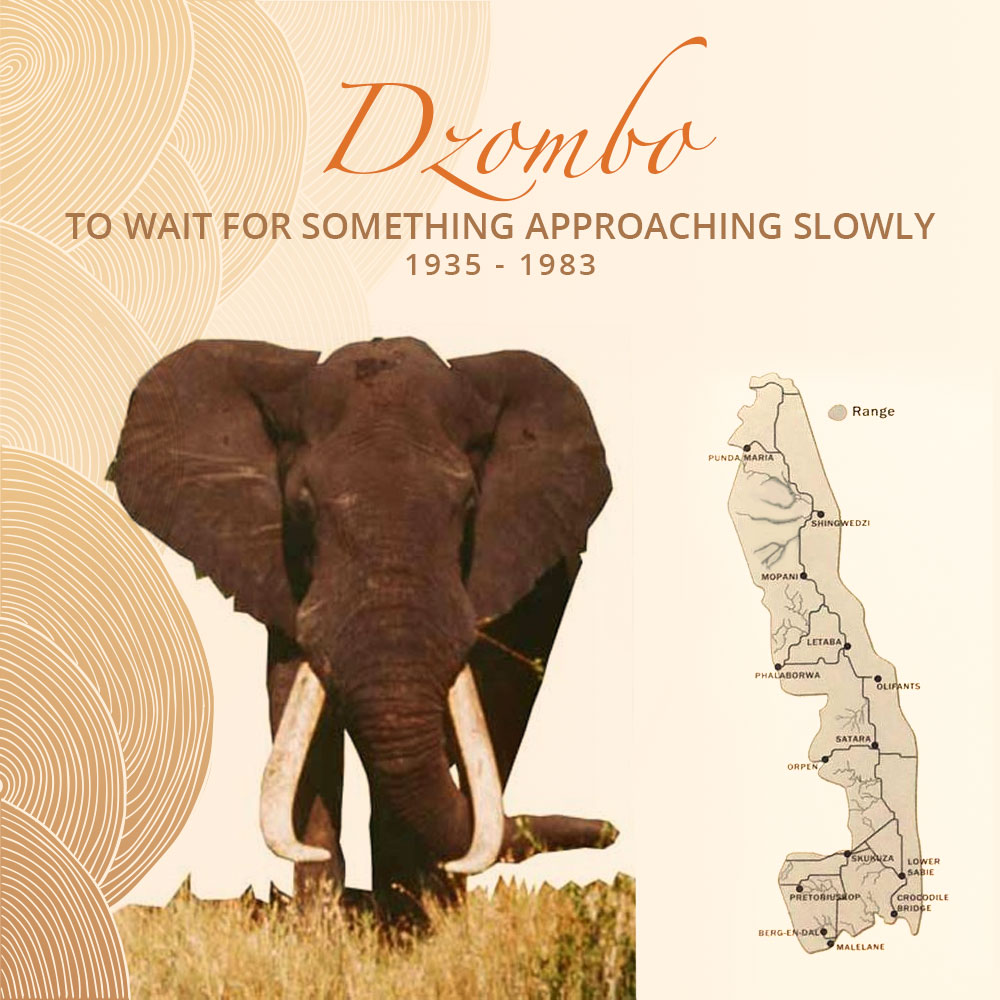
Dzombo died in a deluge of deadly AK-47 bullets, the only one of ‘The Magnificent Seven’ to be killed by poachers. His name is derived from the Tsonga word dzombolo which translates to, ‘to wait for something that slowly approaches’
Age
In October of 1983, a poacher from neighbouring Mozambique cruelly fired hundreds of AK-47 bullets until the mighty elephant finally died an agonising death in an area close to the Dzombyane watering hole.
As the axes of the poachers cruelly chopped into the flesh to remove the unrivalled tusks, game ranger Ampie Espag interrupted them, and although the killers managed to flee, the magnificent set of ivory was left behind. Dzombo was estimated to be half a century old when he was killed.
This giant tusker was named after the Dzombo Spring that meanders through the Mopani Flats in the area between The Shingwedzi and Shawu Rivers.
Range
Until his death in 1983, he was frequently seen in the grassy vlei areas of the Shawu Valley that nestles between the Letaba, Tsendze, and Shingwedzi Rivers. Dzombo shares his name with a stream in this area that is located in the northern regions of the Kruger National Park.
Tusks
Dzombo’s tusks are unequalled in near matching perfection, and with the classic shape that Kruger elephants present - curved tusks that bow and point forward and a little up. After being left behind by poachers who were disturbed by park rangers, the tusks were recovered and can be seen at Letaba Rest Camp’s Elephant Hall Museum.
| TUSK DATA | LEFT TUSK | RIGHT TUSK |
|---|---|---|
| Length | 237cm | 237cm |
| Weight | 56.8kg | 56.8kg |
| Circumference at base of lip | 50cm | 51cm |